
Detect and isolate CD8+ T cells with a broad range of Peptide-MHC complexes or customized products.
Dextramer® – the Backbone of Precision Immune Monitoring
s
Dextramer® Technology
Dextramer® reagents are designed to help researchers and clinicians worldwide obtain high quality results.
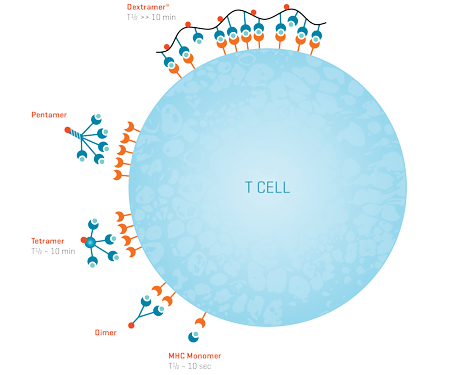
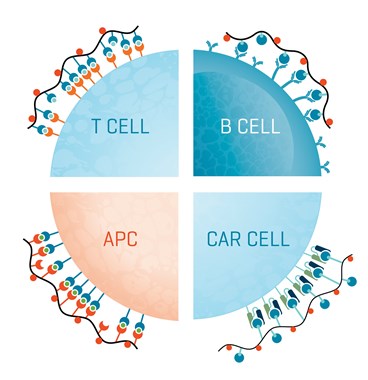
They contain multiple binding sites and numerous fluorophores on a flexible dextran backbone which is optimized to boost avidity in binding antigen-specific T cells. This results in reliable detection, even when T cells are rare or have low affinity receptors. That same configuration is at the core of other Immudex products that enable multiplexing and analysis of other cell types to unravel complex immune responses.
Over 20% of papers studying antigen-specific T cells using MHC Dextramer® are published in high impact Nature and Science journals.
 Read more
Leave No T Cell Undetected
Reveal Critical Biology that Other Multimers Miss
The high avidity of Dextramer® reagents means they remain bound to their target cells significantly longer than other multimers. As a result, Dextramer® enables highly sensitive detection of CD4+ and CD8+ T cells - even with low affinity receptors or at low cell counts.
But Dextramer® doesn’t “just” improve sensitivity - it reveals critical biology that other multimers miss:
- Identify T cells with low affinity TCRs (often memory cells with therapeutic potential).
- Recover functional clonotypes missed by tetramers (including dominant tumor- and virus-specific responses).
- Get a more complete understanding of differences in patient immune responses.
- Avoid false negatives in epitope discovery – validate epitopes missed by tetramers.
- Benefit from richer insights into TCR diversity and T cell biology.
See more performance data
Capture Clinically Relevant Low Affinity T Cells
Low affinity T cells are critical components of the immune response¹. Mounting evidence shows that conventional lower order multimers such as tetramers fail to detect certain T cells - missing functionally relevant clonotypes, low affinity interactions, and even entire epitope-specific populations.
For example, a study in melanoma TILs showed that tetramers failed to recover 80% of Melan A-reactive T cell clonotypes. Three of these tetramer-negative clonotypes were highly functional, killing autologous melanoma cells and accounting for 44% of the entire Melan A-response in a cured patient.²
Missing those T cell clonotypes with tetramers risks underestimating the most clinically relevant part of the response. Dextramer® reveals the full diversity of TCR clonotypes.
See more performance data
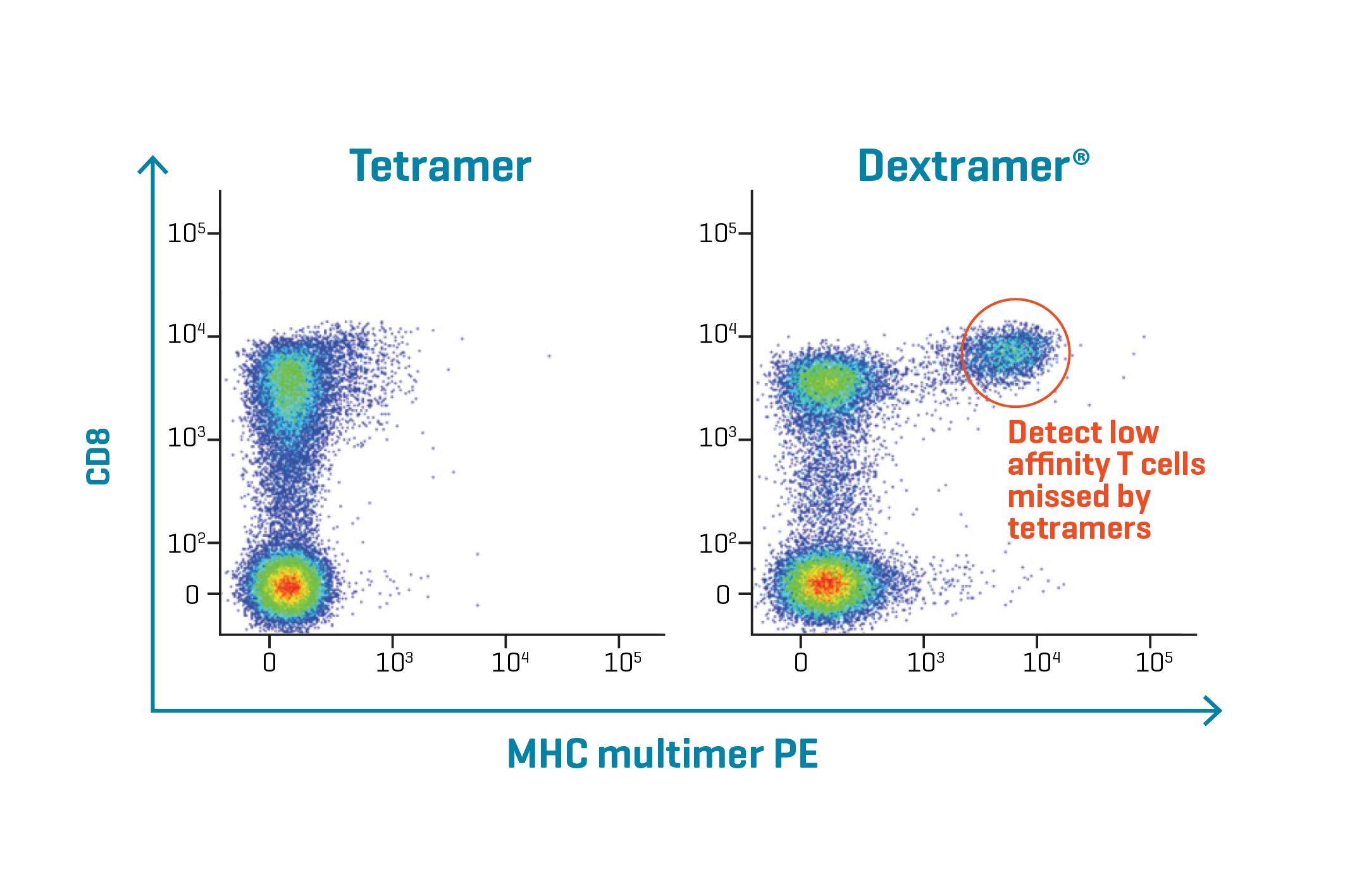
Adapted from Dolton et al. 2014 (Ref. 3).

Direct Detection of Antigen-Specific T Cells
Techniques such as ELISpot (Enzyme-Linked Immunospot) quantify the number of antigen-specific immune cells by detecting cytokine or antibody secretion in response to in vitro stimulation. Hence, these methods detect activated cells which secrete cytokines or antibodies under stimulatory conditions.
Activated cells may not always be identical to antigen-specific cells.
Dextramer® staining directly detects antigen-specific T cells. In addition, you can easily stain with other surface or intracellular markers, enabling even deeper characterization of the T cell population.
Count on Reproducibility
Stringent quality standards are the hallmark of our manufacturing process. Every production lot undergoes meticulous scrutiny in-process and prior to release to minimize lot-to-lot variation.
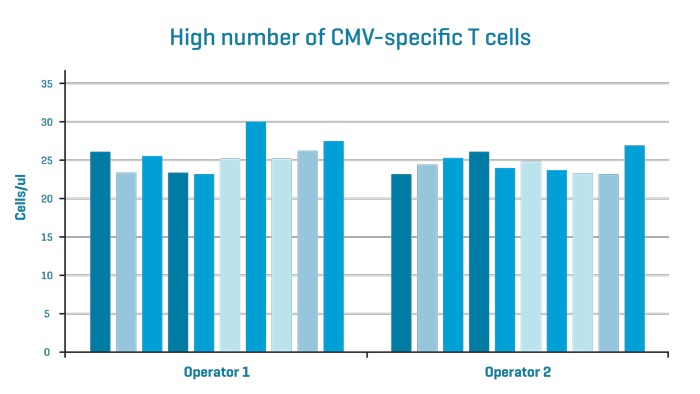
The outcome is reproducible results, again and again. Two operators using ten different lots of MHC Dextramer® to detect CMV-specific T cells generated comparable cell counts.
We are committed to providing high quality reagents, simple protocols and outstanding support from start to finish, ensuring reliable and reproducible results.
T-cell Monitoring via Flow Cytometry and In Situ Staining

MHC Class II
Identify antigen-specific CD4+ T cells with defined or customized MHC allele-peptide combinations.
MHC Alleles List
Explore our growing list of over 90 MHC alleles for human, mouse and primate.
Go Further



References
¹. Martinez et al. 2015. Frontiers in immunology. https://doi.org/10.3389/fimmu.2015.00468
². Rius et al. Journal of Immunology. https://doi.org/10.4049/jimmunol.1700242
³. Dolton et al. 2014. Clinical and Experimental Immunology. https://doi.org/10.1111/cei.12339
The dCODE® technology is disclosed in granted and pending patents within the WO 2015/185067 and WO 2015/188839 patent families including US11402373, US11585806, US11668705, EP3155426, EP3628684, HK1236546, HK40026921, AU2015271324, AU2019264685, AU2021204496, CA2951325, SG11201610177, JP6956632 and JP7271465.