

Decipher adaptive immunity with reagents for T cells, B cells and beyond.
Detect T cells That Other Technologies Miss
Dextramer® reagents don’t “just” improve sensitivity - they reveal critical biology that other multimers miss.
Don’t Risk Missing Critical Biology
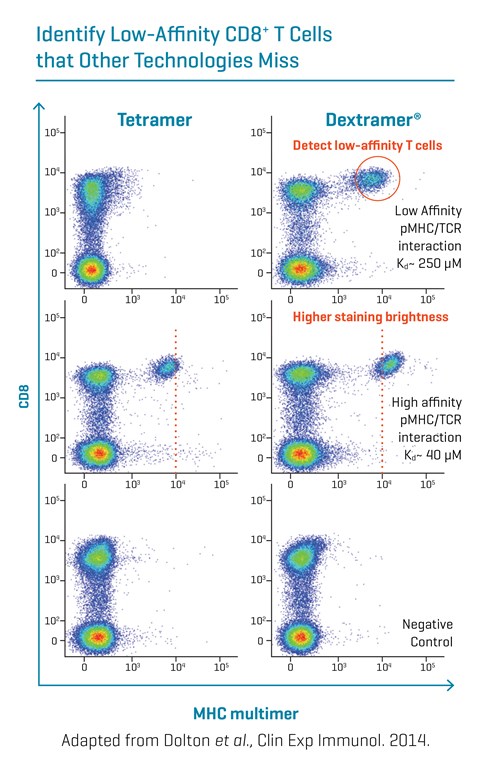
Dextramer® reagents are optimized with a high number of peptide-MHC complexes that increase the avidity for T cells, allowing reliable detection – even of rare or low affinity T cells.
These rare or low affinity T cell clones are a critical part of the immune response1 - driving persistence in tumors, shaping viral escape, or tipping the balance in autoimmunity.
Dextramer® enables the detection of antigen-specific T cells that tetramer cannot detect2, uncovering antigen-specific populations that could not previously be identified.
Dextramer® reveals the full diversity TCR clonotypes:
- Identify T cells with low affinity TCRs (often memory cells with therapeutic potential).
- Recover functional clonotypes missed by tetramers (including dominant tumor- and virus-specific responses).
- Get a more complete understanding of differences in patient immune responses.
- Avoid false negatives in epitope discovery – validate epitopes missed by tetramers.
- Benefit from richer insights into TCR diversity and T cell biology.
Detect Low Affinity CD8+ T Cells that Other Multimers Miss
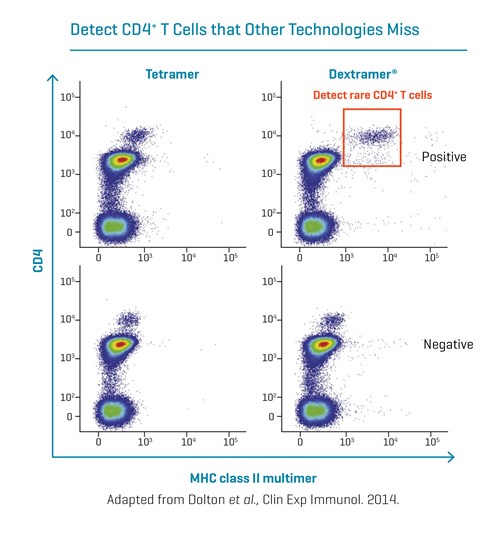
Detect Rare CD4+ T Cells that Other Multimers Miss
What Tetramers Miss
Mounting evidence shows that conventional lower order multimers such as tetramers fail to detect T cell clonotypes which play an important role in the immune response:
- Tetramers stain fewer antigen-specific T cells – in some cases less than half compared to a Dextramer®. 3, 4
- Tetramers fail to detect T cell clonotypes which are fully functional3g. antiviral CD8+ T cells,3, 5 T cell lines6, and antigen-specific CD4+ T cells.7
- Tetramers failed to detect over 70% of the antigen-specific naïve CD4+ T cell repertoire.8
- A study in melanoma TILs showed that tetramers failed to recover 80% of Melan A-reactive T cell clonotypes. Three of these tetramer-negative clonotypes were highly functional, killing autologous melanoma cells and accounting for 44% of the entire Melan A-response in a cured patient.3
Ensure the Highest Resolution
With a high number of fluorophores per molecule, Dextramer® reagents increase fluorescence intensity (MFI), resulting in a clearer separation of the positive T cell population.
Detection of Tumor Infiltrating Lymphocytes. Resolution and MFI using MART1 Dextramer® is three times higher than with Tetramer.
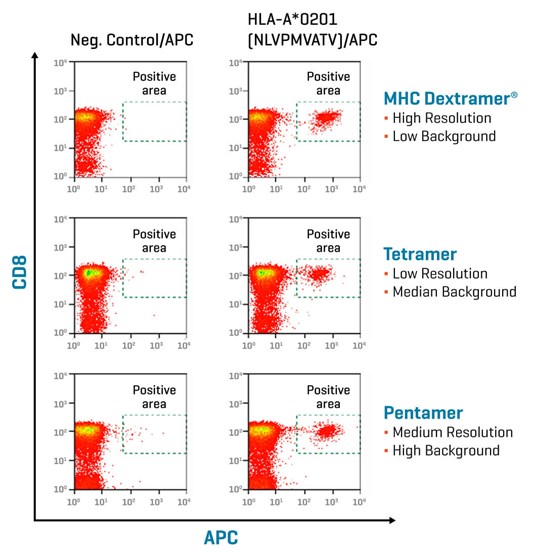
Get a Clear Picture – Highest Resolution With the Lowest Background
Ensure the highest resolution with the lowest background.
Compared to conventional multimer technologies (pentamers and tetramers), higher order Dextramer® reagents can identify antigen-specific T cells with higher resolution and lower background staining.
Since proper controls are at the core of every experiment, we have developed innovative Dextramer® Peptide Pool Negative Controls for a range of different alleles.

High Quality Reagents for Your Research
Rigorous quality control is a core part of our manufacturing process.
An internal comparison study was run with three different batches of MHC I Dextramer® reagents specific for EBV, CMV (two different peptides), and Flu.
The study showed that the percentage of CD8+ antigen-specific T cells identified with each batch is comparable.


References
- Martinez et al. Frontiers in immunology. https://doi.org/10.3389/fimmu.2015.00468
- Dolton et al. Clinical and Experimental Immunology. https://doi.org/10.1111/cei.12339
- Rius et al. Journal of Immunology. https://doi.org/10.4049/jimmunol.1700242
- Tungatt et al. Journal of Immunology. https://doi.org/10.4049/jimmunol.1401785
- Khan et al. Immunology. https://doi.org/10.1111/j.1365-2567.2010.03326.x
- Dolton et al. 2018. Frontiers in immunology. https://doi.org/10.3389/fimmu.2018.01378
- Sabatino et al. J. Exp. Med. https://doi.org/10.1084/jem.20101574
- Martinez et al. Nature Communications. https://doi.org/10.1038/ncomms13848