
“Assess the ability of each antigen recognition domain to specifically bind to its target.”
5 Tips for the Optimal Detection of CAR-T cells
A Crowded Development Space Calls for Precision Tools
CAR-T cell therapies represent a monumental leap in cancer treatment. As the number of CAR-based therapies under development rises, the generalized detection tools that were sufficient to characterize a handful of similar constructs are inadequate to capture the diversity of an increasingly crowded development space. Continued success in CAR-T cell therapy development hinges on the precise characterization of these engineered cells.
So, what should you be looking for in a CAR detection technology? The following are five key areas to consider, along with brief descriptions of how CAR Dextramer® reagents align with each.
1. Confirm the Presence, Identity, and Binding of your CAR
The presence of a CAR construct on a T cell doesn't guarantee its therapeutic efficacy. What is more important is to demonstrate that the detected CAR is the right one and that it successfully binds its target antigen. Unlike many of the detection antibodies that signal the expression of CAR by binding to segments of the construct itself, antigen-based reagents present the CAR’s target epitope and thus, confirm that the construct works.
Demonstrating that your CAR binds its target aligns with regulatory guidance, such as the FDA's recommendation to evaluate the specific binding capabilities of a CAR and demonstrate that its signaling domains initiate T-cell activity.¹
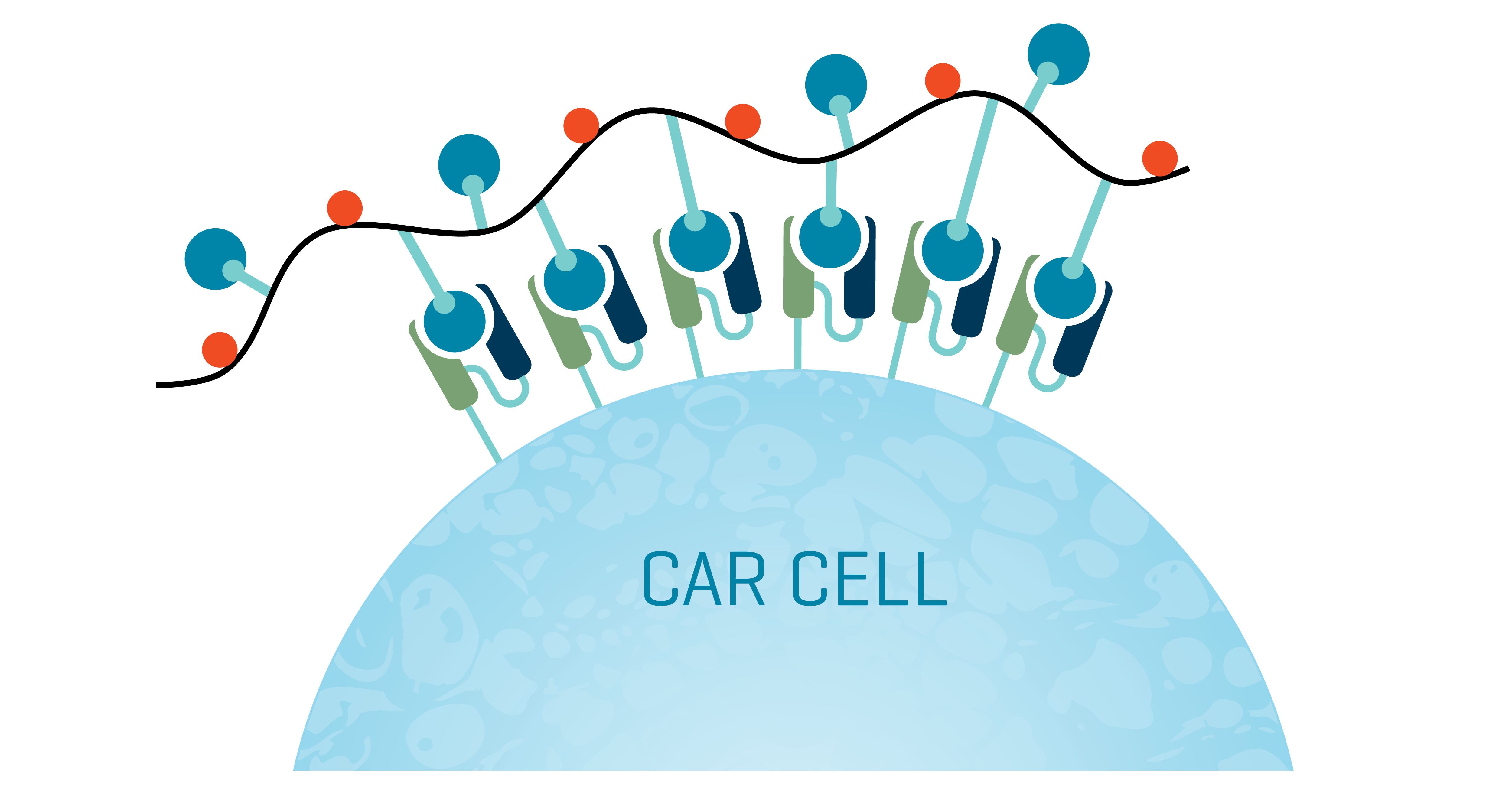
CAR Dextramer® reagents present target antigens in a multivalent manner on a dextran backbone, mimicking the natural interaction between the CAR and its target antigen on a cell surface. This provides a direct evaluation of antigen recognition and binding, offering a biologically relevant assessment of CAR function.
2. Secure the Economic Viability and Commercial Scalability of your Assays
The journey from bench to bedside requires practical and scalable solutions. Readily available commercial detection reagents that are CAR or antigen-specific cover only the most commonly used CAR targets, like CD19 and BCMA. Beyond those, it may be necessary to develop custom antibodies, which incurs significant time and cost.
Antigen multimers, such as CAR Dextramer® reagents, offer a faster and more economical alternative. With a well-established and robust architecture of biotinylated antigens and fluorophores bound to dextran, customizing the reagent to your detection needs is more straightforward and much faster than developing new antibodies. In addition, their deployment involves a simple, one-step protocol, which makes it easier to expand the throughput of assays.
Immudex can provide CAR Dextramer® reagents at scale for clinical trials and larger studies. We also have the capability to manufacture GMP-compliant Dextramer® reagents.
3. Leverage Reagents with Broad Applicability and Adaptability
A versatile detection reagent is a powerful asset in the rapidly evolving field of CAR-T cell engineering. In the case of a CAR detection, versatility pertains to a reagent’s ability to detect any CAR construct.
For example, say you are exploring different CAR constructs targeting the same antigen. Do you need dedicated reagents for each construct type? With antigen-based reagents like CAR Dextramer®, the answer is “no”. Designed to present the target antigen, the reagent is agnostic to the CAR construct itself. The reagent will detect all CARs targeting the same antigen, simplifying reagent inventory and experimental design, and standardizing assays to facilitate comparability.
In some situations a universal reagent to detect the presence of a CAR on the surface of cells may suffice. However, as the structure and features of CAR constructs evolve and expand, leveraging antigen-based detection will prove to be overall a more adaptable detection strategy. Antigen-based reagents can be used in multiplexed staining² and may enable a more nuanced characterization of bivalent, gated, and other complex constructs that operate by binding to more than one antigen.
With CAR Dextramer® reagents, this broad applicability of an antigen-based reagent is coupled to an extensively adaptable antigen repertoire. Immudex developers can design Dextramer® reagents for virtually any CAR, provided the antigen is available, including novel non-scFv-based constructs.
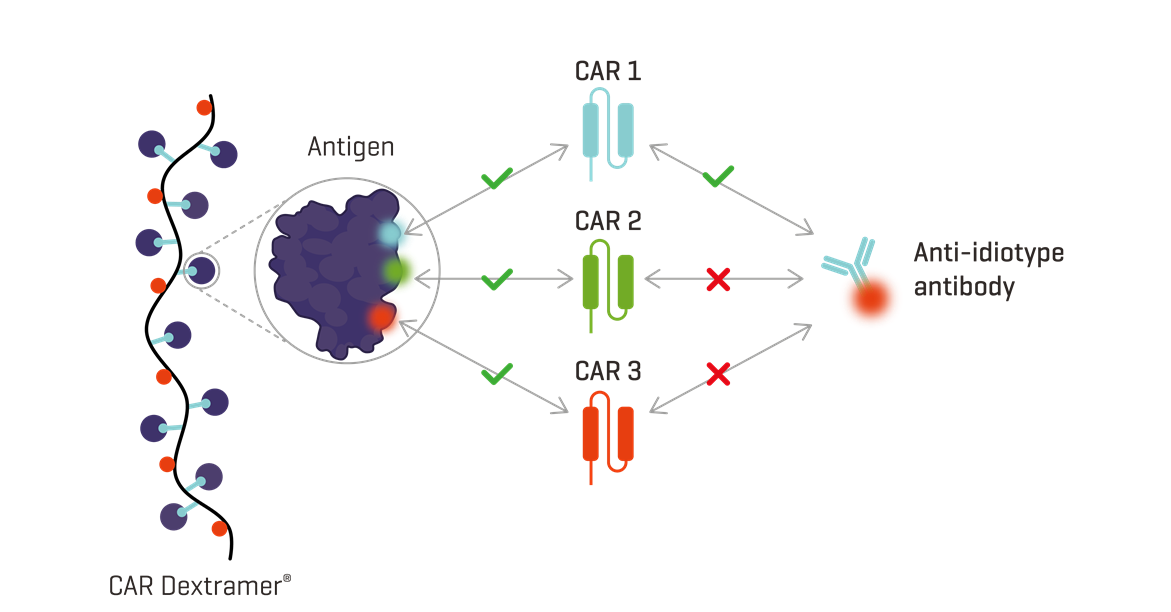
Figure 1. Antigen-based detection reagents like CAR Dextramer® can detect CAR cells with any construct targeting the same antigen, whereas anti-idiotype antibodies are usually more specific to the particular CAR construct. Antigen-based detection reagents also confirm that the CAR cell successfully binds the target antigen. In contrast, anti-idiotype antibodies merely confirm the presence of the CAR construct on the T cell and give no information about whether the CAR construct can bind its target antigen.
4. Opt for Sensitive Reagents to See the “Lower Tail” of CAR
The ability to detect low numbers of CAR-T cells, cells with low CAR expression, or cells with low CAR affinity is critical for accurate monitoring and informed clinical decision-making. Especially in this context, multivalency, multiple fluorophores per reagent molecule, and a high avidity are all essential factors for highly sensitive detection. CAR Dextramer® reagents feature all three.
CAR-T cells low in numbers |
T cells with low number of CAR receptors per cell |
CAR-T cells with low affinity |
|
Clinical trials of CAR-T cell therapies often fail due to low CAR-T cell persistence. Thus, highly sensitive patient monitoring is essential to tease apart factors determining patient response. Using a higher concentration of CAR Dextramer® reagents may boost signal in such cases. |
Low-expressing CAR-T cells with few CAR receptors per cell still offer therapeutic benefit but require high sensitivity for detection. Multivalent CAR Dextramer® reagents may have a higher binding strength when CAR density is low. Plus, the reagent can be custom-designed to enhance signal brightness. |
The therapeutic effect of a CAR-T cell reagent may depend on a weak binding interaction with its target antigen. For example, the second-generation anti-CD19 CAR construct called CAT is characterized by low affinity compared to FMC63-based constructs but shows enhanced expansion and anti-tumor activity.³ This low affinity can be suboptimal for detection. However, CAR Dextramer® reagents can be custom-designed and optimized for each target, tailoring detection even for CAR receptors with inherently low affinity. |
Achieving the right sensitivity for a given CAR-based cell product is a challenging task. As a first step, it’s important to assess cell viability and exclude dead cells from analyses. A high proportion of dead cells in samples forces the use of more reagents for proper detection. As previously mentioned, higher concentrations of reagents like CAR Dextramer® can boost the detection of low-abundance cells (make sure to follow our staining protocol). Finally, but certainly not a last option, our experts can help troubleshoot and optimize your assay or custom-design CAR Dextramer® reagents for enhanced performance with your CAR target.
Never Forget Proper Controls
Robust experimental design hinges on appropriate controls. For CAR-T cell detection, negative controls are indispensable for differentiating specific CAR binding from non-specific background signals.
Immudex can provide guidance and options for negative controls. Dextramer® negative controls confirm non-binding by the CAR of interest, and untransduced controls serve to assess background signal.
These controls establish a baseline of non-specific binding, ensuring that the detected signals are truly due to the desired CAR-antigen interaction.
5. Easily Add Deep Phenotyping and Multi-omics to your Workflow
Detection is just the first step in characterizing CAR-T cells. Phenotyping, activation and cytotoxicity assays, and multi-omic analyses grant additional insights to ensure the successful transition of a product to the clinic. Each evaluation, however, adds to process and analysis complexity. Reagents that reduce protocol steps and minimize handling are easier to scale up and gentler on cells.
CAR Dextramer® reagents enable detection and phenotyping in a single, straightforward workflow with gentle staining and minimal washing steps, thereby preserving cell viability and integrity. Additionally, CAR Dextramer® reagents are readily combined with our DNA barcodes – Immudex's dCODE® technology – for multi-omics analyses of cell population subsets and even individual cells. The outcome is unparalleled analysis depth and comprehensive phenotype profiling, all from a single sample.
Make No Compromises
Developing novel CAR-T cell therapies demands no less than the most precise and robust detection tools. The success of these groundbreaking treatments, from early development to clinical application, hinges on the ability to accurately characterize engineered cells. Conversely, this means prioritizing sensitive and therapeutically relevant detection, meeting budgetary and scalability demands, leveraging adaptable detection tools, and seeking ways to learn more about your cells with streamlined, easy-to-deploy workflows.
At the advent of a new era in treatment options, reaching the clinic quickly and cost-effectively is important. But compromising on the quality and a tractable understanding of your product is not an option. With their alignment across the five critical areas we described above, CAR Dextramer® reagents stand for optimal CAR-T cell detection.
References
- 2024. Guidance Document: Considerations for the Development of Chimeric Antigen Receptor T Cell Products. www.fda.gov/regulatory-information/search-fda-guidance-documents/considerations-development-chimeric-antigen-receptor-car-t-cell-products (accessed June 2025).
- Chang, J. 2021. MHC multimer: a molecular toolbox for immunologists. Molecules and Cells 44: 328.
- Michelozzi, I.M. et al. 2020 The enhanced functionality of low-affinity CD19 CAR T cells is associated with activation priming and polyfunctional cytokine phenotype. Blood 136: 52.
Further Resources

Custom CAR Dextramer®
We design and produce reagents for you, based on your specific targets.